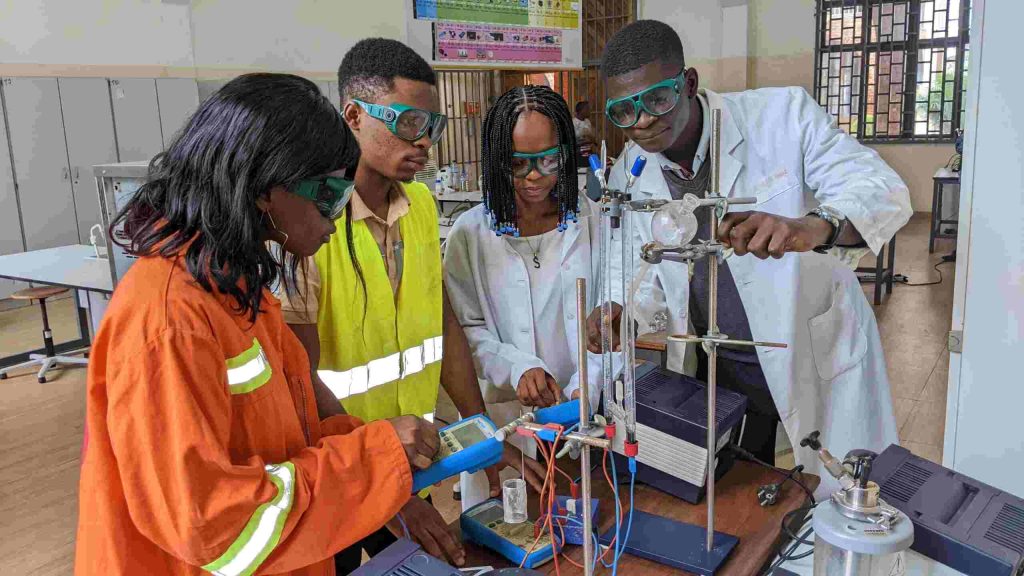
Following the 8 July 2021 conference by Professor Kanda, Dean of Engineering at UNILU, on leadership style, another distinguished speaker, Emeritus Professor Jacques Navez, who holds a doctorate in differential geometry, gave a conference at Mapon University on scientific research.
Following remarks by the Secretary-General for Academic Affairs, Professor Navez addressed administrative and teaching staff, students and guests from Kindu, opening with an engaging account of scientific research’s importance to society. “Humanity has always sought to understand the world and society in which it lives. For centuries, scientific research has sought to meet that need. Research first has a cultural dimension — knowing and understanding nature — but because it enables mastery of nature, even at its most fundamental level, it also involves power and influence.” He then offered a commonly accepted definition of scientific research:.
“Scientific research primarily means all actions undertaken to produce and develop scientific activities.” By extension, it also refers to their social, economic, institutional and legal framework.
The speaker then traced the beginnings of scientific organisations to the sixteenth century, particularly Francis BACON (1561–1626), who clarified the idea that science can and should organise society. These reflections inspired the creation of the Royal Society in 1660, followed in the seventeenth and eighteenth centuries by academies. Research became a profession in the nineteenth century with the emergence of the first professional researchers. Research and technology policies since the Second World War reflect recognition of this reality. The example of the Manhattan Projectillustrated scientific research’s importance to society, even where some research may be harmful.
The speaker highlighted several reasons research matters:
- Promoting scientific research is an essential foundation for successful modernisation.
- Updating state institutions to meet globalisation and competitiveness requires a strong scientific foundation aligned with rapid technological advances across sectors.
He also discussed research in developing countries. Priorities include training scientists locally and organising research while adapting Western teaching approaches. Revising mathematics curricula was emphasised in light of conditions in the DRC.
« . . . Western science cannot simply be exported unchanged to developing countries: it may not meet their economic needs or may depend on specialised institutions that cannot be established locally.
Researchers trained abroad may struggle to readapt, especially when their research does not interest local decision-makers. They may lack administrative support for work disconnected from their cultural environment. Isolated technological projects can also damage natural resources and traditional cultures.”
After the presentation, the University’s research club was introduced by coordinator Junior Meme and its three-member steering committee. He requested support from professors and teaching assistants and encouraged broad student participation.
The session ended with the student coordinator urging participants to recognise the importance of scientific research and develop an interest in it.
Badesire Edgar (bac+1)
Katumbi Moïse (prepo/pol.)